The 7 Best RV Bike Racks (Reviews For 2026)
If you’re an avid cyclist and enjoy hitting the open road on your bike, you’ll know that one of the biggest challenges can be how to take your bike with you on a road trip. Unless you want to spend hours lugging your bike around in the back of your RV, you’ll need a top RV bike rack!
RVs are the best way to travel with everything in reach, but if you’ve spent any time in an RV, you know it’s always a battle to find the space to fit everything you need. And anyone that enjoys a good bike ride, should have a bike rack for their RV.
We’ve also included a How to Install and RV Bike Rack section with a step-by-step guide, so you’ll have no worries about setting up.
RVExpertise.com is reader-supported. When you buy through the links on our site, we may earn an affiliate commission. Visit our disclaimer page for more information.
Best Bike Carriers For RVs
| Swagman RV Approved Traveler XC2 with Bumper Adapter | Let's Go Aero Jack-It Double Bike Carrier System | Swagman RV Approved 2-Bike Bumper Rack | |
|---|---|---|---|
 |  |  | |
 |  |  |
|
| Bike Capacity: | 2 Bikes | 2 Bikes | 2 Bikes |
| Mounting: | 2" Hitch Receiver or Bumper Mount | Mounts over the tongue jack | Bumper mount |
| Weight Capacity: | 70 Pounds | 80 Pounds | 60 Pounds |
| Other: | Powder coat finish resists corrosion and rust | NoMotion pins minimize bike wobble | Powder-coating resists corrosion |
Quick Answer: The 7 Best Rated RV Bike Racks For 2026
- Swagman RV Approved Traveler XC2 with Bumper Adapter
- Let’s Go Aero Jack-It Double Bike Carrier System
- Swagman RV Approved 2-Bike Bumper Rack
- KUAT Sherpa 2.0 Lightweight Aluminum Compact Hitch Rack
- Swagman RV Approved Around the Spare Deluxe Bike Rack
- Camco RV Ladder Mount Bike Rack
- Thule T2 Pro XT/XTR Hitch Bike Rack
Best RV Bike Rack Reviews
1. Swagman RV Approved Traveler XC2 with Bumper Adapter
- Bike Capacity: 2 Bikes
- Mounting: 2″ Hitch Receiver or Bumper Mount
- Weight Capacity: 70 Pounds
- Other: Powder coat finish resists corrosion and rust
I have run a Swagman rack on two different rigs now, and the Traveler XC2 is the one I keep coming back to when I need to haul two bikes that are not the same size.
What it actually is. This is a two-bike rack built from alloy steel, rated for 35 pounds per bike, so it will carry most adult mountain bikes and road bikes without you thinking twice. It will not carry an e-bike. Those run heavier than that almost every time, so check your bike’s actual weight before you assume this rack works for it.
How the bikes attach. Each bike gets its own push-button ratchet arm that clamps onto the frame. You squeeze the button, swing the arm down onto the top tube, and it locks in place. I like this system better than the strap-and-hook setups on cheaper racks, because it holds the bike still on a rough gravel road instead of letting it rock against its neighbor for four hundred miles.
How it mounts. You have two options here. It fits a standard 2-inch class 3 hitch receiver, which is what most people will use, or it mounts straight to a 4.5-inch continuous welded steel RV bumper using the 2-inch bumper adapter that comes in the box.
If your rig has a bumper that flexes or is not a true welded steel bumper, skip this route and use the hitch instead. A bike rack on a weak bumper is how you end up with a bent bumper and two bikes in a ditch.
Wheel size and fit. The sliding wheel hoops handle anything from a 20-inch kid’s bike up to a 29-inch mountain bike wheel, and you do not have to pull the front wheel off to load most bikes. That matters more than it sounds like it should. Pulling a front wheel every time you load up gets old by day three of a trip.
Storage and finish. The whole thing folds flat when you are not using it, so it does not eat up bay space or hang off the back of your rig looking like an afterthought. The alloy steel frame gets a black powder coat, and after a couple seasons of salt air and gravel roads mine still looks close to new, no rust bubbling up at the welds.
Security. A cable lock runs through the frame so you can lock the bikes to the rack itself, not just to each other. I use mine every time I leave the bikes overnight at a campground I do not know well. It will not stop someone with bolt cutters and thirty minutes to spare, but it stops the opportunist walking by at 2 a.m., which is the more common problem.
The one real complaint. Installation on this one is more fiddly than Swagman’s simpler single-bike models. Getting the bumper adapter aligned and torqued right the first time took me longer than I expected, closer to forty-five minutes than the fifteen you might guess from the box. Once it is on, it stays on, and day to day use is simple. Just do not rush the first install.
Bottom line. If you are hauling two bikes of different sizes, maybe a mountain bike and a kid’s bike, and you want something that folds away clean when it is not in use, this is the rack I would point you to. Skip it if you are running an e-bike or anything heavier than 35 pounds, since that is past what this frame is built for.
2. Let’s Go Aero Jack-It Double Bike Carrier System
- Bike Capacity: 2 Bikes
- Mounting: Mounts over the tongue jack
- Weight Capacity: 80 Pounds
- Other: NoMotion pins minimize wobble
This one is heavier than most of the racks on this list, close to 25 pounds on its own, and that weight is doing real work. It is rated for 80 pounds total, 40 pounds per bike, so it will carry heavier mountain bikes and e-bikes that would max out a lighter rack.
How it holds the bikes. Instead of clamping the frame, this rack carries each bike by its wheels, using SwayControl cradles and a pair of lockable NoMotion pins to keep everything pinned in place. I trust a wheel-based system more than a frame clamp for a heavier bike, since there is less flex and less chance of scuffing the paint on an expensive frame.
Where it mounts. This is built for A-frame travel and cargo trailers, not a hitch receiver. It sits up on the tongue of the trailer instead of hanging off the back, which frees up your rear hitch for a cargo carrier, a second bike rack, or towing something else entirely. If you already use your rear hitch for anything else on a trip, this is the rack that solves that problem.
The PowerTower design. The frame is built to shield your tongue jack from getting knocked around, which matters more than people think until they have watched a rock kick up and dent an unprotected jack. It also puts the bikes high enough that you can actually see them in your side mirror while you are driving.
That last part sounds minor until you have used it. You stop pulling over every twenty minutes on a gravel road to check if a bump knocked something loose, because you can just glance at the mirror and keep driving.
What is in the box. You get two SwayControl cradles, two lockable NoMotion pins, and three bolts for mounting the whole system to your A-frame. Installation is a one-time job over the tongue jack, not something you are taking on and off at every stop.
Bottom line. This is a sturdy, well-built rack, and the SwayControl cradles do what they say. Your bikes will not rattle or slide around back there, even on a rough road. It sits high and out of the way, so your rear hitch stays free for whatever else you need it for on that trip.
The tradeoff is the extra weight and the fact that it only works on A-frame trailers, so if you are running a fifth wheel or a motorhome, this one is not for you. For a heavier bike on a travel trailer where the rear hitch is already spoken for, it is worth the weight.
3. Swagman RV Approved 2-Bike Bumper Rack
- Bike Capacity: 2 Bikes
- Mounting: Bumper mount
- Weight Capacity: 60 Pounds
- Other: Powder-coated to resist corrosion
This is the second Swagman on this list, and it is the simpler, cheaper option if you do not need everything the Traveler XC2 offers.
What it fits. This one bolts straight to your RV bumper instead of a hitch. It is built for a 4 to 4.5-inch continuous welded steel bumper, and that word continuous matters. Swagman is clear that this rack is not rated for aluminum bumpers or spot-welded ones, so measure and check your bumper type before you order this, not after it shows up.
Capacity. It carries less than the Traveler XC2, topping out at 30 pounds per bike, 60 pounds for the pair. That is plenty for most kids’ bikes and lighter adult bikes, but it will not cover a heavier mountain bike or anything close to an e-bike. If your bikes run heavier, look at a hitch-mounted rack rated higher instead of forcing it onto this one.
Build. The frame is alloy steel, finished with black paint and a powder coat on top of that, which is the same rust protection you will see on most of Swagman’s lineup. It holds up fine through a normal camping season of gravel roads and rain, in my experience with Swagman’s coatings on other racks.
Installation. This is genuinely simple. You bolt it to the bumper with the included long bolts and you are done, no adapters or extra hardware to track down. It is the easiest install of any bike rack I have set up on an RV.
Bottom line. This rack does one job at a reasonable price, and it does that job well if your bumper qualifies and your bikes fit under the weight limit. It will not work on every RV, since plenty of bumpers out there are not the continuous welded steel type this rack needs, so check yours first.
If you already know your bumper qualifies and your bikes are on the lighter side, this is the rack I would tell a friend to buy over spending more on a hitch-mounted setup they do not need.
4. KUAT Sherpa 2.0 Lightweight Aluminum Compact Hitch Rack

- Bike Capacity: 2 Bikes
- Mounting: Hitch mount
- Weight Capacity: 80 Pounds
- Other: Rack pivots, works with 1.25″ & 2.0 hitch sizes
This is a tray-style rack, not a hanging one, which matters more than people think. The bikes sit in trays and get held by their wheels instead of hanging by the frame, so there is no frame contact and no risk of the rack scuffing an expensive paint job.
Hitch fit. The Sherpa works in either a 1.25-inch or a 2-inch hitch receiver, and it comes with a 2-inch adapter so you are not stuck buying a separate one. Confirm your RV or tow vehicle’s receiver size before ordering, since the wrong size adapter is the most common return reason on racks like this.
How it holds the bikes. You get a 3-point connection, two tray arms on the bottom for the wheels and a vertical arm on top locking the bike to the rack. Kuat’s two-way anti-wobble system is doing real work here, and it holds up fine on pavement and light gravel. On rougher washboard roads, a few owners have found the ratchet arms can loosen slightly over a long trip, so it is worth a quick check at your first fuel stop if the road has been rough.
Capacity. It carries two bikes at 40 pounds each, 80 pounds total, which covers most mountain bikes and a fair number of e-bikes depending on the model. Check your actual bike weight against that number before you assume an e-bike will fit, since plenty run heavier than 40 pounds on their own.
Access to a rear door. If your RV or trailer has a rear door or hatch, this rack tilts back so you can open it without pulling the whole rack off the hitch. That is a real convenience if you are in and out of a rear storage door daily at a campsite, not just a spec sheet feature.
Build and visibility. The tray loops and padded arms hold the bike without touching the frame directly, so scratching is not really a concern here. There is also a rear safety reflector built in, which is a small thing but worth having if you are ever pulling into a campground after dark.
Storage. It folds up when you are not hauling bikes, so it is not sticking straight out behind your rig the whole trip.
Bottom line. This rack works well on both RVs and regular vehicles, and the tilt-back design is the feature that will actually change your daily routine if you use a rear door often. The one thing to watch is those ratchet arms after a stretch of rough road. Give them a check rather than assuming they are still as tight as when you loaded up.
5. Swagman RV Approved Around the Spare Deluxe Bike Rack
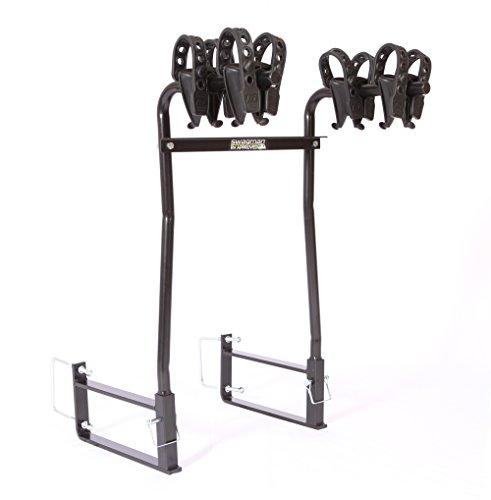
- Bike Capacity: 2 Bikes
- Mounting: Spare tire mount
- Weight Capacity: 70 Pounds
- Other: Anti-sway cradles prevent bike-to-bike contact
This is the third Swagman on this list, and it solves a problem the other two do not. If your spare tire lives on the back bumper, most bike racks either will not clear it or block access to it entirely. This one mounts around the spare instead of fighting it.
What it fits. Like the other Swagman bumper racks, this needs a 4 to 4.5-inch continuous welded steel bumper. Same rule applies here as with their other bumper-mounted racks. It is not built for aluminum bumpers or spot-welded ones, so check yours before you buy, not after the box shows up.
Capacity. It carries one or two bikes at up to 30 pounds each, 60 pounds total. That covers most kids’ bikes and lighter adult bikes, but it is not the rack for a heavier mountain bike or an e-bike. If your bikes run heavier than that, you will want a hitch-mounted rack rated higher instead.
How it holds the bikes. The frames sit in anti-sway cradles that rotate to fit different bike shapes, and rubber straps hold everything in place. The cradles are the reason your two bikes will not be knocking paint off each other by the time you reach camp, which is the actual failure point on cheaper racks that skip this part.
Spare tire access. This is the feature that sets it apart from Swagman’s other bumper racks. Release pins let you pull the top half of the rack off entirely, so you can get to your spare without unbolting the whole unit from the bumper. That matters more than it sounds like until you have a flat on the road and need that tire fast.
Installation. You get all the hardware you need, U-bolts and brackets to clamp it to the bumper and straps to secure the bikes once it is on. It is a straightforward bolt-on job, closer to the simple end of Swagman’s lineup than their hitch-mounted racks.
Bottom line. If you carry a spare tire on your rear bumper and do not want to give up bike storage or spare access to get it, this is the rack built for exactly that situation. It will not carry heavy bikes, and it will not work on the wrong bumper type, so confirm both of those before you order.
6. Camco RV Ladder Mount Bike Rack

- Bike Capacity: 2 Bikes
- Mounting: Ladder rack
- Weight Capacity: 60 Pounds
- Other: Easy installation
This one skips the hitch and the bumper entirely. It hooks onto your RV’s ladder instead, and that is the whole reason to consider it over the racks above.
Why the ladder mount matters. If you already use your hitch for towing a car dolly or another trailer, this rack does not fight you for that space. It hangs off the ladder most RVs already have on the back, so you are not choosing between bikes and towing capacity. That is the actual selling point here, not the price.
Fit and compatibility. It is built for standard RV ladders, and Camco notes it may not work well with some smaller-framed bikes, so check the cradle dimensions against your bikes before you buy if you are running anything unusual. If your RV does not have a rear ladder, this rack is not an option for you at all, so this is not the universal fit some listings make it sound like.
Capacity. It holds two bikes at a combined maximum of 60 pounds. That is enough for most standard bikes but leaves no room for a heavy mountain bike or anything close to an e-bike, so weigh your bikes if you are not sure.
Build. Camco lists this as heavy-duty steel construction, not aluminum, so do not go in expecting an especially light rack. It weighs about 8.2 pounds on its own, which is light enough to hang and unhook by hand without much trouble. The bikes sit in form-fit cradles that Camco describes as soft rubber, and the included straps add a second layer of hold beyond the cradles themselves.
Storage. It folds flat when you are not using it, so it is not sticking off the back of your ladder for the whole trip if you only bike part of the time.
Bottom line. If your RV has a rear ladder and your hitch is already spoken for, this is a straightforward way to bring two standard bikes without buying a hitch you do not otherwise need. It will not work if you do not have a ladder back there, and it will not carry heavier bikes, so those two things rule it out fast if either applies to you.
7. Thule T2 Pro XT/XTR Hitch Bike Rack

- Bike Capacity: 2 Bikes
- Mounting: Hitch mount
- Weight Capacity: 60 Pounds
- Other: Works with 1.25″ & 2.0 hitch sizes, add allows 4 bikes
Before anything else on this one, there is a real limitation you need to know before you shop for it. Thule rates this rack for motorized RV travel only, meaning Class A and Class C motorhomes, at a reduced 40 percent load capacity.
It is not approved for travel trailers, fifth wheels, or bumper-mounted receivers. If you are pulling a trailer, this is not your rack, no matter how good the rest of this review sounds.
What it actually is. This is a vertical hanging hitch rack, not a two-bike setup. It comes in a 4-bike and a 6-bike version, and the bikes load by rolling the front wheel straight into a wheel basket, so there is no lifting a bike up onto a tray. Spacing between bikes is a generous 12 inches, which is enough that pedals and brake levers do not tangle even with a full load.
Capacity. The 6-bike version carries up to 250 pounds total, 55 pounds per bike, which covers most mountain bikes and a fair number of e-bikes. On a motorhome, remember that 40 percent reduction Thule requires. Do the math on your actual load before you assume the full 250 pounds applies to your setup.
Tire and wheel fit. It handles 20 to 29-inch wheels, with a separate adapter needed for the smaller sizes, and tires up to 5 inches wide with Thule’s fat tire basket accessory sold separately. Out of the box it fits standard tires up to 3 inches, so budget for that basket if you are running true fat bikes.
Weight of the rack itself. This is a heavy piece of equipment on its own, close to 84 to 87 pounds depending on which version you get. Add your bikes on top of that and you are looking at real tongue weight, so check your hitch and receiver rating before you load this up, not after.
Rear access. The tilt-down design gets you into a rear hatch or door without pulling bikes off first, and Thule’s dual TiltAssist damper does real work here, lowering and raising the loaded rack without you fighting the weight the whole way. Reviewers who have run this rack note the empty rack takes more effort to lower than the loaded one, since the damper is tuned to assist with weight, not fight against nothing.
Build. Steel construction, no frame or fork contact since the bikes sit in the wheel baskets held by rubber straps. That is worth something if you are hauling a carbon frame bike you do not want scuffed.
Bottom line. If you have a Class A or Class C motorhome and want to carry a real fleet of bikes without lifting them onto a tray one at a time, this rack does that well. If you are towing a travel trailer or fifth wheel, skip it entirely and look at a rack actually rated for that kind of use, since Thule is explicit that this one is not approved for it.
Buyer’s Guide For RV Bike Racks
Here we look at bike racks for RVs and what makes the best ones stand out. We also offer advice on what things you need to consider before buying one, and we’ve included a step-by-step guide and video on how to install a bike rack on your RV.
What Makes a Great Bike Rack for an RV?
There are several features that make a great RV bike. So, when purchasing a new one, keep an eye out for the following:
Quality of the Materials
One of the major factors to consider with anything, and of course that includes RV bike racks is the quality of materials used to construct it. You need to ensure the rack will last a long time, so look for powder-coated units as they extend the metal’s life and are corrosive-resistant. The weight distribution rating and the number of bikes it can handle also depend on the material used.
Adjustable Racks
There are plenty of the racks available that are not adjustable enough to fit every kind of bike. So make sure the one you buy is adjustable enough or at least can fit your bikes easily. And always remember, you may go with friends from time to time.
Mounting Process
The ease of installing a bike rack on an RV depends on the model and type you are going to use. Different types require different methods of installation. Choose one that is easy to install, and at leats then you’ll have a good start to your next trip.
Can Any Bike Rack Be Used on an RV?
Not all kinds of bike racks can be used on an RV. There are different models made with different features, and some of them are specially designed for particular vehicles. Some of them are designed to be attached to a vehicle’s roof while others attach to the bumper, or ladder etc.
There are also different models for SUVs, trucks, or trailers. So, don’t just expect any bike rack to work for your RV.
Aspects to Consider Before Buying an RV Bike Rack
Before buying a bike rack for your RV, always consider the following:
Carrying Capacity
How many bikes do you plan on bringing on a regular basis? Most bike racks can support two bikes, but there are options out there with bigger capacities if you’re traveling with a few people or want to bring a couple different kinds of bikes.
Bike Size and Frame
Some racks are better suited for specific types of bikes more than others. For example, hanging mounts can be difficult to use on kids bikes or certain types of women’s bikes with a slanted frame.
Every rack has a maximum weight capacity. Heavier equipment like mountain bikes may be too much for certain racks, so make sure to check the rack capacity with the weight of the bikes you plan on transporting. The average capacity tends to be about 30 to 40 pounds per bike.
Loading/Unloading Process
Consider how often you plan on using the bikes on each trip. If you think you’ll only get them down once or twice, then a trickier loading process may not be that big of a deal. However, if you know you will be loading and unloading them frequently, make sure you’re getting a rack that makes the process easy.
Models like ladder and roof mounts provide more security, but it’s also harder to reach the bikes, and you usually have to be able to lift the bikes above your head. Wheel mount and frame mount racks provide the best access for frequent loading and unloading.
Mount Options
We will talk about the different mount options in more depth later in the article, but it is important to consider how different types of racks will fit with your bike. Some types of racks will always use the wheels to connect, while others allow you to choose a preference.
Types of RV Bike Racks
With all of these rack types, always make sure the model you are considering works for RVs and campers. Some are designed to attach to a hitch or bumper of a car and are not safe to use on larger recreational vehicles.
Hitch Mount
Hitch mounts are a very popular choice. As the name implies, they attach to the back of the RV and sit far enough away to avoid causing damage to the body of the vehicle. If your RV has a compatible hitch or receiver, they are a great option because they provide easy access for loading and unloading.
Ladder Mount
Ladder mount racks are usually fairly inexpensive and are easy to install. They mount on to the rear ladder and are available in both platform and hanging styles. They’re better suited for lightweight bikes since they typically sit pretty high up on the RV and you have to lift the bikes above your head to place them in the rack.
Bumper Mount
Bumper mount racks are typically built for RVs with square bumpers. If your RV is deigned differently, it is best to look into other options. Bumper mounts are convenient and easy to use, and most can support between two to four bikes at a time. They also free up your hitch for other towing uses.
Benefits of Investing in a Quality Bike Rack for Your RV
Investing in a high-quality bike rack may be a little pricier, but you will be happy you did in the long run. High-ranking racks like the ones on our list have unique, durable designs that make them suited for RVs and campers. Not all bike racks work well on larger vehicles and can cause damage.
Quality bike racks provide security, durability, and flexibility, which are all incredibly important when you are transporting bikes over long distances. You want to be sure that there are features to protect your bikes against common issues, such as theft from an insecure locking system or paint damage from too much bike-to-bike contact during transport.
Many of the top brands, such as Swagman, provide a lifetime warranty when you purchase one of their products. Instead of having to replace your rack every couple years, you can invest in a quality model that will last for a long time with many repairs covered.
How to Install an RV Bike Rack
The following are some steps that you can follow to set up and install a bike rack on your RV easily:
- To install the rack, you will have to find a place along your a-frame. Know where the equalizer connections, propane tank, and battery plate are and acquaint yourself with the wiring going through the frame.
- Insert the angled post. On both sides, there are two posts to be inserted in, they simply slide in the original trailer brackets.
- Now, mount the trailer bracket on the post. If the post is at a specific angle, the integrated openings on the bracket’s back side will permit you to rotate this bracket so that it meets the bicycle rack.
- With the assistance of screws, you can tighten everything down once the rack is all set up.
- Then you will see the bolts holding the bracket on to the base you connected before. You will also see a quick-release pin. These will permit you to fold the rack down if you have a hybrid trailer with a folding bed in the front.
- To have the best access to the rack, pull up the legs, and adjust the rack over the propane tanks.
- Insert the thumbscrews into the posts, which will help to keep everything secure and set up.
- You would then be able to install the support arm by connecting its brackets to the base of the wrench post by simply utilizing a screw and wingnut framework.
To understand the process visually, here’s a video of the whole process:
FAQs About RV Bike Racks
Still, have some questions in mind? The following section will help you understand RV bike racks further, the type of model that will suit you, and potential problems you might face.
Does a Bike Rack Void an RV’s Manufacturer Warranty?
This could be a little difficult to answer as bike racks can damage parts of your RV, and that damage could be hard to claim to the manufacturer. Manufacturers will hesitate to believe if the rack had caused the damage to the trailer and might void the warranty.
Are RV Bumper Bike Racks Safe?
Bumper bike racks are generally safe, but the added length and weight distribution could cause problems in some cases. The added weight of the rack transfers the RV’s balance unknowingly towards the back and makes it hard for you to operate and park the vehicle.
How Many Bikes Can You Attach to the Back of an RV?
This could highly depend on the model you want to buy and your personal preference. An average bike rack is designed to carry two to four bikes, but there are racks also specially made to carry up to six bikes.
Top Rated Bike RV Racks: Bring Your Two-Wheeler on Every Road Trip
Bike racks provide a space-efficient and secure solution for bike storage and transportation. Finding a high-quality rack that fits your RV and bike will free up more space inside your RV, protect your bike from theft and damage, and allow you to bring multiple bikes along on a trip.
As you know, RV bike racks are not created equally, and there are different types. So, always make sure you know exactly what it is you want, so you can bring enough bikes with you on every road trip.
That said, after reading this blog post, you should now have a better understanding of bike racks for RVs and how to choose the right one for your needs. We hope that you found it helpful and that you’ll be able to enjoy many cycling adventures on the open road! Thanks for reading and happy cycling.
Features
Ease Of Use
Value
The Swagman RV Approved Traveler XC2 with Bumper Adapter is our Editors Choice for the best RV bike rack

Hello, fellow wanderers! I’m Alyssia. Since 2008, my husband and I have called an RV our home, journeying through life one mile at a time. Our nomadic lifestyle has led us to over 70 countries, each with their unique tales that have shaped our own.
I share our stories and insights right here, hoping to inspire and guide you in your own adventures. Expect tips on RV living, our favorite camping spots, breathtaking hiking trails, and the joys and challenges of an ever-changing view from our window. Alongside, you’ll also find practical advice on outdoorsy stuff, designed to equip you for any journey. Join us as we continue to explore the vast, beautiful world on wheels!